
Contents
Foreword
Introduction
A note on methodology
A note on authorship
Chapter 1: The UK’s place in the global AI race
- The UK and Singapore
- Case study: use of AI in Singaporean public services
Chapter 2: AI in government: Perspectives from the UK’s digital leaders
- Setting direction around AI – vision, design and plan
- Departmental drivers – collaboration and accountability
- Developing an AI-ready workforce – transformation leadership and people
Chapter 3: Jump-starting the AI revolution
- Three fundamentals
- A roadmap for AI in government
- Time to hit the accelerator
- Interacting with Redbox

Supported by:

Foreword
by Cognizant, our knowledge partner for Digital Leaders 2024
Artificial Intelligence (AI) represents a potentially transformative shift for government – one that could revolutionise policymaking, national security and the delivery of public services. As we stand at the cusp of this technological evolution, it’s a privilege and a responsibility to consider the profound implications and opportunities AI offers UK government.
That’s why Cognizant was delighted to sponsor Global Government Forum’s Digital Leaders Study 2024, which explores the UK government’s preparedness for adopting AI.
As a digital and data delivery partner to the UK government since 2017, we welcome the report’s emphasis on AI’s potential to revolutionise how government operates. Delivering an AI-powered government requires a clear understanding of what this technology can achieve. And it also needs more than just technological expertise; it requires public trust, won through transparency and wise regulation.
This report underscores the critical imperative for a unified AI vision and for coordinated action across government departments. The consolidation of AI bodies within the Department for Science, Innovation and Technology (DSIT) is a step in the right direction, unifying AI leadership and setting the stage for a cohesive strategy that transcends silos in pursuit of deep collaboration.
The report delves into other core issues such as the critical role of data quality, better understanding of AI investment pathways, and building more nuanced regulatory frameworks. It envisions a future where AI is seamlessly integrated into government, driving efficiency, transparency and public service excellence. And it highlights the need for frugal innovation and learning from other leaders around the world, most of all Singapore’s proactive and practical approach to AI integration.
As the new government starts work on delivering its five missions for the UK, the role of technology cannot be overlooked. This report offers a roadmap for that AI journey, with insights and recommendations on how to harness it for the betterment of people, communities and public infrastructure.
This report underscores the critical imperative for a unified AI vision and for coordinated action across government departments
Embedding AI across government departments and functions is not just a strategic choice – it’s a necessity to ensure the UK remains competitive and responsive in an increasingly digital world. Its potential to enhance efficiency, reduce costs, and improve outcomes is immense. And the UK can lead the way.
So, while the journey ahead may be challenging, it’s a journey the UK must undertake and do so with foresight, responsibility, and determination. I trust this report will play a key part in informing the UK’s approach to the AI race in the coming years.
Yatin Mahandru
Vice-president and head of public sector & health,
Cognizant, September 2024

Introduction
As we worked on Digital Leaders 2024, UK politics shifted significantly. We now have a new government (elected with a landslide majority), facing a difficult inheritance and keen to present itself as a group of pragmatic fixers. It’s doing this with strict fiscal constraints which mean that reform, not higher spending, must be the path to putting public services back on track.
At the same time, the past 24 months have been defined by a remarkable new wave of AI. Governments, private companies and individual citizens around the world are embracing generative tools that look set to offer huge productivity gains and appear highly disruptive. Within government, it’s set to be far more transformative than digital was in changing how the state operates.
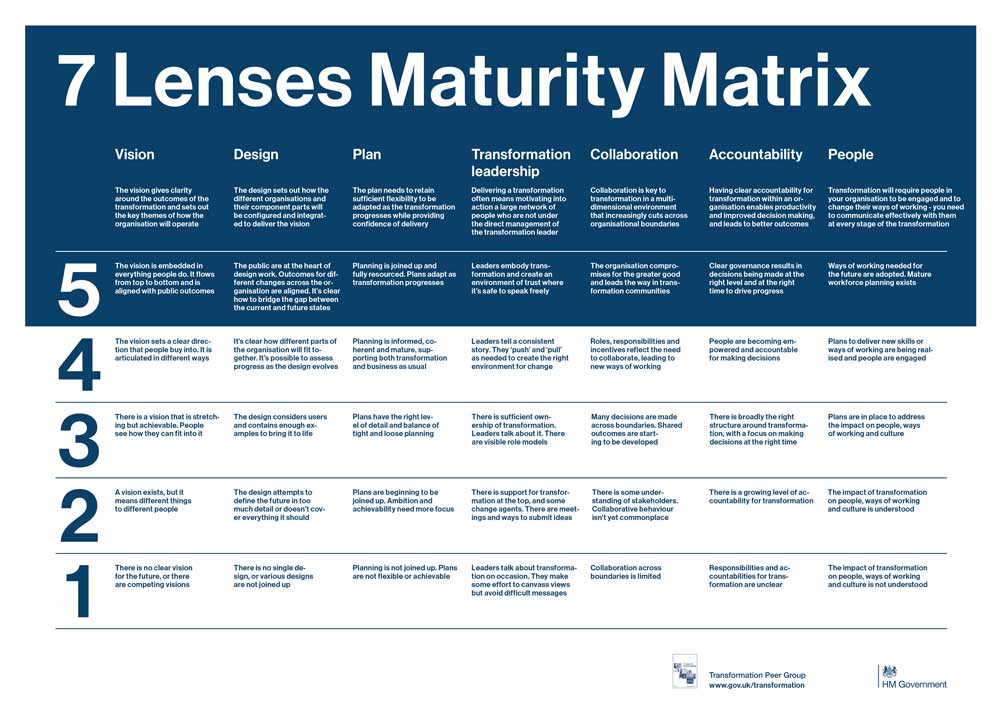
This Digital Leaders 2024 report sits squarely between these two developments. Using the 7 Lenses of transformation as our guide (as in our previous Digital Leaders reports), we interviewed 10 UK leaders in government to understand how ready the state is to transition to AI. Their views provide invaluable insights.
Unfortunately, we heard that the UK is far from ready to capitalise on the opportunities offered by AI. This was encapsulated by a comment made in one interview that when it comes to implementing AI within government: “It’s like we’re driving a car with one foot very firmly pressed down on the accelerator and one foot pressed down on the brake.”
We were told that Whitehall is doing exemplary, even world-leading work around standards and AI safety. The first AI Safety Summit hosted at Bletchley Park and the AI Safety Institute are both good examples of this. Policy efforts like these are what this interviewee is referring to as ‘the brake’.
On the other hand, there’s considerable ministerial interest and external hype about AI, including from supportive think-tanks and private sector experts. This is creating huge expectations about what AI can offer and some early innovative work on this within government too – this is ‘the accelerator’.
There’s little evidence of a well-understood cross-government vision for AI yet
Both are important. We should be managing risks and exploiting the opportunities of AI at the same time. But, as interviewees told us again and again, the practical work that must underpin ‘the accelerator’ – the testing, trialling, implementing and scaling-up of AI applications – isn’t anywhere near advanced enough. There’s lots of talk, but not enough action to make sure we really are hitting that accelerator.
This was clear across all 7 Lenses of transformation. For example, there’s little evidence of a well- understood cross-government vision for AI yet, let alone a fleshed-out design or plan. Some departments are rushing ahead in its absence (while others move more slowly), but there’s little coordination or collaboration of this activity. We have a long way to go on these and the other lenses. In the final section of this report, we provide detailed recommendations for each lens, drawing on lessons from past successful digital transformation programmes in government.
Overall, this may sound like a pessimistic outlook. But the new government has already taken steps to improve this situation.
By consolidating the Central Digital and Data Office (CDDO), Incubator for Artificial Intelligence (i.AI), and the Government Digital Service (GDS) within DSIT, they have created a clear, unified voice for AI in government. It addresses one of the overriding concerns raised by interviewees: the lack of a single source for AI leadership. The new hub should be an invaluable first step to addressing this failing.
And there are other reasons to be hopeful. While finances are undoubtedly squeezed, this creates space for frugal innovation and focuses minds on the need for reform. The advancements around AI are already impressive and show few signs of slowing. And so, with this new configuration of AI bodies in Whitehall, there’s a chance to reset the government’s approach – with a new AI vision underpinned by practical actions.
In other words, we can improve – and improve fast. It just takes a government that’s willing to be bold and seize the opportunities that AI presents. Our message to them is clear: they should do exactly that. It’s time to commit to AI and really press down on the accelerator.
Kevin Cunnington
September 2024

A note on methodology
This edition of Digital Leaders focuses on the topics of AI and data within the UK government. The primary research source was 10 interviews with digital leaders in government today, exploring their perceptions of the UK’s performance on AI across the 7 Lenses of transformation (see Matrix on the following page). We also conducted some additional desk research.
Our 10 interviewees were drawn from different grades and bodies across government. They ranged from permanent secretaries to senior leaders in digital roles. They included people from ministerial departments, the centre of government (comprising No.10 Downing Street and the Cabinet Office), non-ministerial departments, and executive non-departmental public bodies. Quotes from all interviews are unattributed and we have removed identifiable material from them.
We thank all of the following officials for taking part in interviews for this project:
- Susan Acland-Hood permanent secretary, Department for Education
- Victoria Bew head of strategy, i.AI
- Yvonne Gallagher digital director, National Audit Office
- David Knott chief technology officer, UK Government
- Tom Read (then) chief executive officer, Government Digital Service
- Daljit Rehal chief digital and information officer, HMRC
- Tom Smith chief data officer, Department for Levelling Up, Housing and Communities
- Huw Stephens chief information officer, HM Treasury
- Ming Tang chief data and analytics officer, NHS England
- Rob Thompson chief technology officer, Home Office
In addition, Saheel Sankriwala (chief technology officer at the Department for Education) was present for our interview with Susan Acland-Hood and contributed to the discussions.
To augment our research, we used Redbox – a generative AI tool being developed by i.AI – to analyse interview transcripts and provide insights. Crucially, we used this to test the analysis that we had already conducted (without AI tools), rather than as any substitute for doing so. All transcripts were fully pseudonymised before being analysed by Redbox and all data was handled securely.
Some of the Redbox output is included in the appendix at the end of this report.
Further insights were gleaned from the AI Study Tour that Global Government Forum (GGF) hosted in June 2024. During this tour, senior officials from the government of Barbados came to the UK and visited key government units working on AI (such as GDS and i.AI) as well as private companies such as Cognizant and Hippo Digital. This offered a chance to share best practice and build connections between leaders beyond Whitehall, further enhancing our understanding of the global AI race.






 Joanna Murphy,
  President, Detran-SP Oficial, Brazil
 Chief Product Officer, Japan’s Digital Agency
 Ministère fédéral allemand chargé de la transformation numérique et de la modernisation de l’administration,
  Analyste principale au Secrétariat de l’IA au sein du ministère de l’Innovation, Sciences et Développement économique Canada (ISDE)
 Directrice exécutive, la Division de la vie privée et des données responsables, Secrétariat du Conseil du Trésor du Canada (SCT)
 Advisor of the Digital Infrastructure Development, Ministry of Digital Transformation of Ukraine
 Director of Digital Agenda Coordination and Foreign-Funded Projects for e-Government, National Agency of Information Society (NAIS), Albania



 Andrew Trossman, Chief Technologist, DXC Canada
 Sous-directeur général des élections, Transformation numérique, Élections Canada
 Secrétariat du Conseil du Trésor du Canada
 Secrétariat du Conseil du Trésor du Canada



 Commissaire, Commission de la fonction publique, Philippines
 Commissioner, Civil Service Commission, Philippines
 Emploi et Développement Social Canada
 Partenaire, IBM
 Titulaire de la Chaire Jarislowsky en gestion du secteur public et leader du secteur public canadien
 Former Clerk of the Privy Council and Jarislowsky Chair in Public Sector Management

 Sous-ministre adjoint principal, Secrétariat de l’intelligence artificielle, Innovation, Sciences et Développement économique, Gouvernement du Canada

 Sous-ministre au ministère de la Cybersécurité et du Numérique
 Directeur de la technologie sur le terrain, Secteurs essentiels, IGEL
 Président-directeur général, PagoPA, Italie
 Sous-commissaire et Dirigeant principal de l’information,
  Assistant Commissioner and Chief Information Officer,

 Field Chief Technology Officer, Critical Sectors, IGEL
 Sous-ministre adjoint (Services numériques) et dirigeant principal du numérique à la Défense Ministère de la Défense nationale / Forces armées canadiennes


 Chief Service and Digital Officer, Transport Canada
 Associate Deputy Minister and Government Chief Information Officer, Government of British Columbia
 Head of AI Incubation, Government Digital Service, United Kingdom
 Executive Director, Public Sector Canada, SAS
 Innovation, Sciences et Développement économique Canada
 Chief Data Officer, Shared Services Canada
 Vice-président, Conseil canadien des normes
 Directeur de l’expérience numérique, Office of Management and Budget, États-Unis
 Premier vice-président, Services partagés Canada (SPC)
 Dirigeant principal de la technologie et de l’innovation, Commissions malaisiennes de la communication et du multimédia (MCMC)
 Directeur général, Cyberdéfense, Centre canadien pour la cybersécurité
 Cofondatrice, présidente et directrice générale de Blueprint




 Chief Executive Officer, IDIKA SA (e-Government Center for Social Security), Greece



 Chief Information Security Officer and Deputy CIO for Cybersecurity, Department of Energy, United States










 Chef de service chez New Work, gestion du changement, gestion de projet, ministère fédéral du Numérique et des Transports, Allemagne
 Directrice de l’Intégration, la gestion financière à Services publics et Approvisionnement Canada
 Membre et scientifique de données en chef pour les Amériques, Intel




 Directeur Exécutif, Division de la politique de l’accès à l’information et du gouvernement ouvert (DPAIGO), Secrétariat du Conseil du Trésor du Canada (SCT)
 Dirigeant principal des données (DPD) et Directeur général, Direction générale de la recherche stratégique, et l’innovation en matière de données, Services aux Autochtones Canada
 Président de Services partagés Canada
  Données et analyses gouvernementales, responsable de l’industrie, SAS
 Analyste en chef, directrice de la science des données, 10 Downing Street, Royaume-Uni

 Dirigeante principale des données, Services partagés Canada
 Directrice générale, Politique sur le numérique, Secrétariat du Conseil du Trésor du Canada
 Head of Data and Technology, Chief Digital Office, United Nations Development Programme
 Président-directeur général, National Information and Communication Technology Company Limited (iGovTT), Trinité-et-Tobago
 Directrice exécutive, Code for Canada
 Cheffe, Gestion de l’information intégrée, Secteur des services intégrés, Secrétariat du Conseil du Trésor du Canada

 Assistant Deputy Minister and Chief Data Officer, Employment and Social Development Canada
 Dirigeant principal de l’information et sous-ministre adjoint, Services numériques
 Dirigeante principale des données & chef de l’évaluation, Affaires mondiales Canada
 Director, Performance and Oversight, Treasury Board of Canada Secretariat, Canada
 Chief Executive, Government Digital Service, Cabinet Office, United Kingdom






 Directrice exécutive, Gestion de la communauté numérique, Secrétariat du Conseil du Trésor du Canada, Canada
 Directeur général, Rwanda Information Society Authority, Rwanda
 Modératrice de l’événement, Global Government Forum
 Sous-ministre et dirigeante principale de l’information (DPI) du Canada